
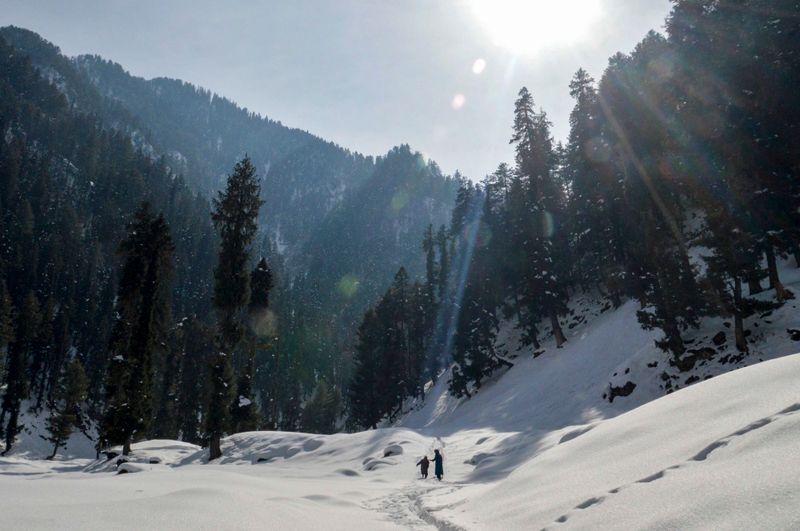
A new study has revealed that several high-altitude locations in Jammu and Kashmir such as the popular tourist destinations of Pahalgam and Gulmarg have warmed up by nearly one degree Celsius in the last two decades, highlighting the sensitivity of the Himalayan environment to ongoing climate change with severe implications for high-altitude hydrology, cryosphere stability and regional climate resilience.
The researchers examined the long-term surface temperature variability across Jammu and Kashmir using ground-based observations and reanalysis data during 1980-2024. The region showed a clear but spatially heterogeneous warming, with the strongest annual mean temperature rise at mid-elevation stations such as Bhaderwah and weak or insignificant trends at lower elevations like Jammu. Minimum temperature showed the most rapid acceleration at several mid-to-high elevation regions.
Jammu and Kashmir region is among the most climate-sensitive mountain environments in South Asia, with its steep elevation gradients, extensive ice and snow cover and reliance on snow and glacier fed rivers making it highly vulnerable to warming-related changes.
Determining whether warming intensifies with elevation in Jammu and Kashmir is essential for understanding future water availability, glacial melt, ecological shifts and downstream socio-economic impacts. Pointing out that the warming phenomenon has not been adequately assessed, the researchers said that this study addresses this gap by quantifying elevation-dependent temperature trends across the region and evaluates their implications for climate resilience in the western Himalayas.
The study, undertaken by researchers from the Indian Institute of Technology Kharagpur and the India Meteorological Department, was published by Nature’s Scientific Reports earlier this month.
Spatial and seasonal contrasts, along with enhanced warming at higher altitudes in specific seasons, indicate the presence of elevation-dependent warming (EDW) in these mountainous regions, the researchers said.
EDW has become a major focus in contemporary climate research because temperature changes in high mountains often differ substantially from those in surrounding lowlands. The primary driver for EDW is snow–albedo, which is the level of solar radiation reflected by snow, where warming accelerates snowmelt and exposes darker surfaces that absorb more radiation and enhance warming at higher altitudes.
Water-vapour and cloud effects are also contributing factors as reduction in atmospheric water vapour at higher elevations weaken radiation absorption and alter cloud cover patterns, intensifying daytime warming. Aerosols such as black carbon also enhance atmospheric heating and accelerate snow or ice darkening.
The researchers further observed that land-use and vegetation changes, including deforestation, modify surface energy fluxes and can enhance or suppress EDW depending on regional conditions. Additionally, meteorological factors, glacier retreat, hydrological shifts and ecosystem responses interact with atmospheric processes by altering surface roughness, moisture availability and feedback loops that further reinforce elevation-dependent temperature trends.
