
The monsoon clouds may be obscuring the skies over many parts of India in July, but beyond them a series of celestial events would be lighting up the heavens during the month.
There are about a dozen spectacular astronomical events scheduled in July according to various sky watchers, but only some of them can be experienced or be visible from India if the skies overhead are clear.
These include:
- Mars and Uranus conjunction on July 4: Among the most spectacular and awaited celestial events, the two planets will experience an exceptionally rare and extremely close alignment, appearing to be just 0.1 degrees apart. This will be their closest conjunction until the year 2053. The planets will rise in the eastern sky after 2:30 AM and will be the easiest to spot before dawn breaks. While Mars will be easily visible to the naked eye as a bright and reddish object, Uranus will appear as a very faint and tiny bluish-green dot next to Mars, which may require optical aids to see.
- Earth at Aphelion on July 6: The Earth reaches its farthest point from the Sun for the year, roughly 152 million km away. The primary effect of this position is a slight decrease in the intensity of sunlight reaching Earth as compared to the time when the Earth is closest to the Sun.
- Moon and Saturn conjunction on July 7: The third-quarter Moon will appear close to Saturn during the night early morning. The pair will climb above the eastern horizon just after midnight and travel in tandem across the sky, with the giant ringed planet resembling a bright, steady golden star that does not twinkle.
- Crescent Moon and Mars on July 10-11: A stunning pairing visible to the naked eye, it can be seen an hour and a half before sunrise in the eastern sky along with the Pleiades, a star cluster also known as the Seven Sisters.
- Mars and Aldebaran on July 13: Mars will shine brightly in close proximity to the red supergiant star Aldebaran. They can be seen with the naked eye in the eastern sky 1-2 hours before sunrise. Aldebaran is a massive orange-red giant star located roughly 65 light-years from Earth. It is the 14th brightest star in the night sky and is also known as the ‘Eye of the Bull’ due to its reddish glow and its position at the head of the Taurus constellation.
- Full Buck Moon and Guru Purnima on July 29: The July full moon will peak at 8 PM and coincides with the Hindu festival of Guru Purnima. Though it is widely being termed as a Supermoon because it falls during a period of larger full moons, some astronomers say that it is not a true Supermoon as it would be at a distance of 3,99,617 kilometres from Earth, higher than the average.
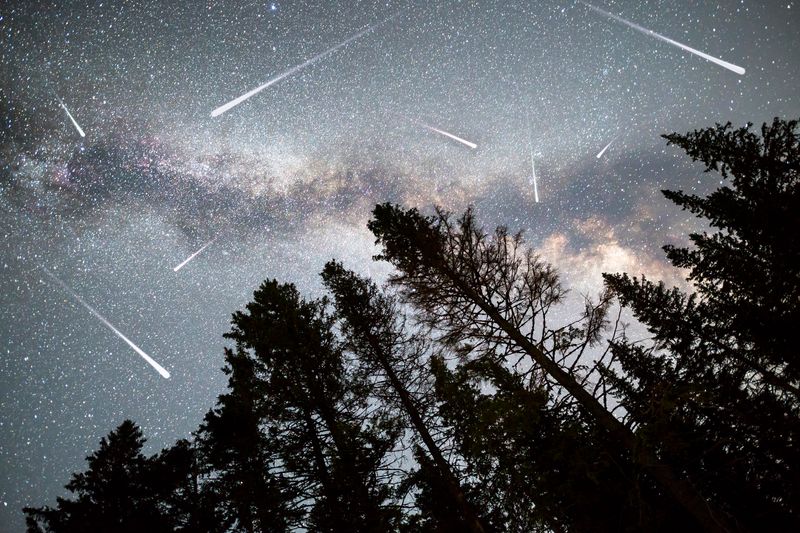
- Meteor Showers on July 30–31: A double meteor shower peaks towards the end of the month. The Southern Delta Aquariids and the Alpha Capricornids may emit up to 30 combined meteors per hour which would be visible under dark skies. These are two distinct annual meteor showers that occur simultaneously every summer. The Aquariids offers a high frequency and steady shower of meteors while the Capricornids is known for intense and dazzling fireballs.
