
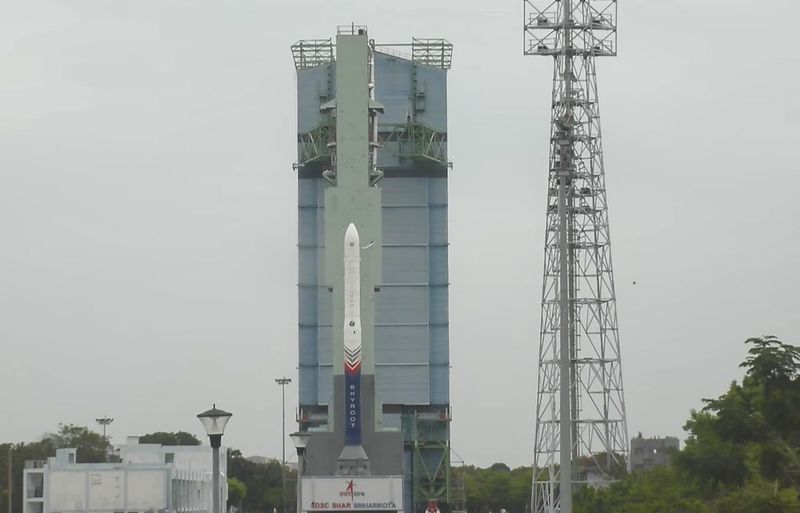
India’s first privately developed orbital rocket, Vikram-1 on Saturday successfully placed multiple technology demonstration payloads and postcards, including from Prime Minister Narendra Modi into a low earth orbit.
Dubbed ‘Mission Aagaman’ (meaning arrival), it marks the entry of India’s private space sector into the orbital launch market, spearheaded by Skyroot Aerospace. The mission was a “grand success,” the company said.
“Vikram-1 has left the pad at Sriharikota. India’s first privately developed orbital rocket is flying. History is being made,” Skyroot Aerospace posted on X.
Lt Gen. AK Bhatt (retd), Director General, Indian Space Association (ISpA) said: “The successful orbital launch of Skyroot Aerospace’s Vikram-1 (Mission Aagaman) is a defining milestone for India’s space journey. By executing the nation’s first fully private orbital flight, Skyroot has shattered legacy boundaries, demonstrating that our domestic industry is primed to handle end-to-end space missions. We are equally proud to congratulate the pioneering tech-demo payloads safely deployed on this flight, i.e. Cosmoserve Space’s EMBRACE robotic arm for orbital debris removal, Skyroot’s own SCOPE and Grahaa Space’s SOLARAS S3 satellite.”
Government reforms are also accelerating the growth of India’s space economy. Valued at approximately USD 8.4 billion today, the sector is projected to grow five-fold to USD 40–45 billion by 2030. It is further aimed to reach USD 100 billion by 2040.
S Somnath former ISRO chairman said, “This is far more than the maiden orbital flight of a rocket, it marks the arrival of India’s private rocket building capability and reflects the remarkable transformation of our space ecosystem. Built on years of innovation, policy reforms, and the strong foundation laid by ISRO, and the energy of the entrepreneurial youth, this mission opens new opportunities for Indian industry, startups, and the global space economy.”
In its maiden voyage, the four-stage, seven-storey-tall Vikram-1 rocket lifted off majestically at 12.05 pm am on Saturday amid cloudy skies from the first launch pad, leaving behind plumes of orange smoke and marking a new era from this spaceport. A “planned hold” due to apparent navigation issues forced a revised launch time of 12.05 pm.
After its ascent, the primary payloads — technology demonstrators from Grahaa Space, Cosmoserve, DCubed, and Skyroot’s SCOPE — were sequentially deployed into a 450 km Low Earth Orbit (LEO).
The vehicle also successfully deployed a micro-art payload, an 18-karat gold rocket and a handwritten postcard from Prime Minister Narendra Modi bearing the message “Vande Mataram”, along with postcards from engineers, scientists, and Indian astronauts.
The miniature micro-art payload, carrying micro-sculptures of doyen of India’s space programeme Vikram Sarabhai, scientist Sir CV Raman and former President APJ Abdul Kalam has been created “as a tribute to three visionaries who shaped India’s scientific and space journey,” the company said.
“Skyroot proudly named its rockets and engines after these icons,” it added.
The engineering data collected during this test flight will be analysed to validate guidance and navigation systems, and to guide future refinements for commercial satellite missions, Skyroot Aerospace said.
With its Saturday mission, Skyroot Aerospace successfully demonstrated its orbital launch capability with the maiden flight of the Vikram-1 launch vehicle, moving beyond the suborbital flight achieved by its Vikram-S mission in 2022.
The successful flight validated the performance of the rocket’s all-carbon composite structure and 3D-printed engines in a real flight environment, features claimed by the company as “first”.
Both Chandana and co-founder Naga Bharath Daka are former ISRO scientists and were present at the space agency’s Mission Control Center (MCC), along with its chief V Narayanan. Former ISRO chiefs, astronaut Shubhanshu Shukla and Andhra Pradesh minister Nara Lokesh were among those who witnessed the launch from the MCC.
This historic milestone is expected to strengthen India’s position in the fast-growing global small satellite launch market, expanding the country’s presence in space alongside ISRO.
The payloads that piggybacked Vikram-1 include Cosmoserve Space’ Embrace (mission name), an in-orbit demonstration of robotic arms capable of removing space debris, Solaras by Grahaa Space which is a compact satellite mission developed to demonstrate new capabilities in LEO.
According to the company, Scope satellite by Skyroot Aerospace is an in-house experimental payload developed to test space technologies in future missions.
Cosmic Bloom, an “artistic lab-grown diamond” by Cosmos Diamonds and German test payload uD3PP and mD3RN by Dcubed also reached the space on Saturday.
with PTI inputs
