
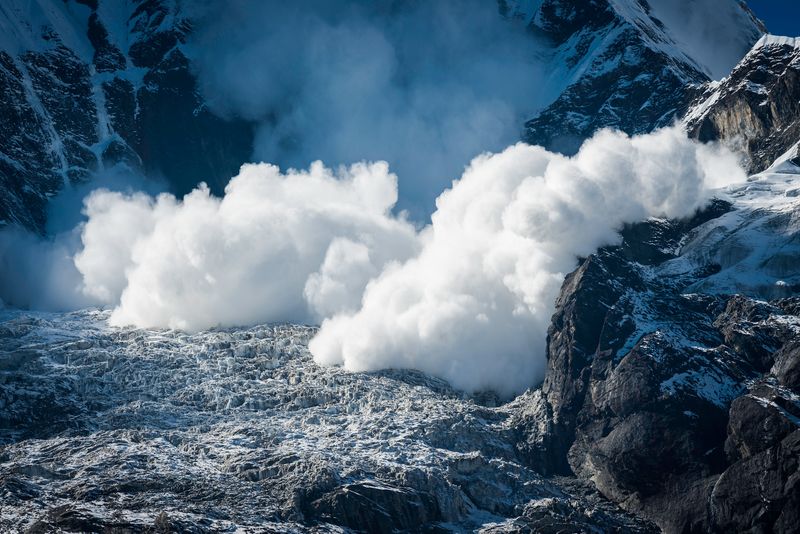
With ice avalanches in the High Mountain Asia (HMA) region becoming more frequent due to climate change, posing serious risks to mountain communities, transportation routes and downstream areas, a group of researchers from Nepal and China has found that these events predominantly occur in the southern, southeastern and northwestern parts of HMA, with a noticeable increase in both frequency and magnitude.
The researchers compiled an inventory of 137 ice avalanche events in the HMA region between 1900 and 2024, based on peer-reviewed literature, technical reports and news sources. They classified the events into three categories — ice avalanches, ice–rock avalanches and glacier collapses — with ice–rock avalanches being the most common.
In HMA, ice avalanches mainly occur on steep slopes and in areas with hanging glaciers, exhibiting strong seasonality, spatial clustering and marked regional variability. They are concentrated in the southern, southeastern and northwestern sectors. In contrast, areas farther north experience relatively few ice avalanches.
“This spatial pattern is strongly influenced by regional climate and glacier distribution and activity. The Himalayan region is wetter and hosts more extensive and dynamically active glaciers, resulting in a higher frequency of ice avalanches, whereas the colder and drier northern mountains have limited glacier coverage and therefore exhibit far fewer documented events,” the researchers said.
Observing a statistically significant shift in the frequency of ice avalanche events in HMA around 2000, the researchers said that before 2000, the occurrence of ice avalanches increased only gradually, at an average rate of 0.01 events per year. In contrast, the post-2000 period has witnessed a markedly accelerated increase of about 0.10 events per year, indicating a distinct phase of intensified ice avalanche activity and the destabilisation of glacierised slopes under rapid atmospheric warming. Furthermore, the size of individual ice avalanche events has consistently increased since 1900, with larger events becoming more frequent.
A review article titled “Advances and challenges in monitoring, risk assessment, and early warning of ice avalanches in High Mountain Asia”, authored by 11 researchers from Lumbini Buddhist University and the International Centre for Integrated Mountain Development in Nepal, and the Chinese Academy of Sciences, was published in Elsevier’s Earth-Science Reviews on October 24.
Multiple factors influence the occurrence of ice avalanches, with climatic factors being the most frequently reported triggers, followed by glaciological factors and external disturbances such as earthquakes and rockfalls. Geomorphological and geological conditions, as well as intrinsic glaciological characteristics, are rarely documented as triggers because they primarily act as long-term preconditioning factors that influence glacier stability rather than as time-specific causes of failure.
Ice avalanches frequently trigger secondary hazards. Among the 137 compiled events, nearly 70 per cent were associated with cascading hazards, including debris flows, glacial lake outburst floods (GLOFs) and the formation of dammed lakes. Some events involved multiple secondary hazards.
The Chamoli ice–rock avalanche in February 2021, when a large-scale ice–rock avalanche occurred in Uttarakhand and rapidly descended into a valley, triggering high-velocity debris flows and floods that resulted in more than 200 fatalities and destroyed multiple hydropower facilities, is one prominent example cited by the study.
Another example is the cascading hazard event in Sikkim in October 2023, when an ice avalanche and a landslide entered an adjacent glacial lake, triggering a GLOF that caused extensive damage to buildings, bridges and farmland.
The researchers said that despite substantial progress in recent years, several key gaps remain in monitoring, risk assessment and the development of early warning systems. Existing systems remain fragmented and are often used in isolation, without a comprehensive and systematic observational framework, resulting in inconsistent data quality and a lack of standardisation.
Risk assessment remains constrained, while operational early warning systems are underdeveloped. Difficult terrain, challenging environmental conditions, limited infrastructure and funding, and weak institutional coordination hinder their deployment. Additionally, the insufficient integration of local community knowledge diminishes situational awareness and the effectiveness of warnings.
The study identified three key areas of focus: creating integrated monitoring networks that combine spaceborne, airborne and ground-based observations for continuous, near-real-time tracking of glacier instability; developing standardised, multi-hazard risk assessment frameworks that address interactions and cascading effects between ice avalanches and secondary hazards; and designing operational, regionally adaptable early warning systems that integrate monitoring, dynamic risk assessment, warning issuance and downstream response while accounting for regional infrastructure, technical capacity and institutional coordination.
