
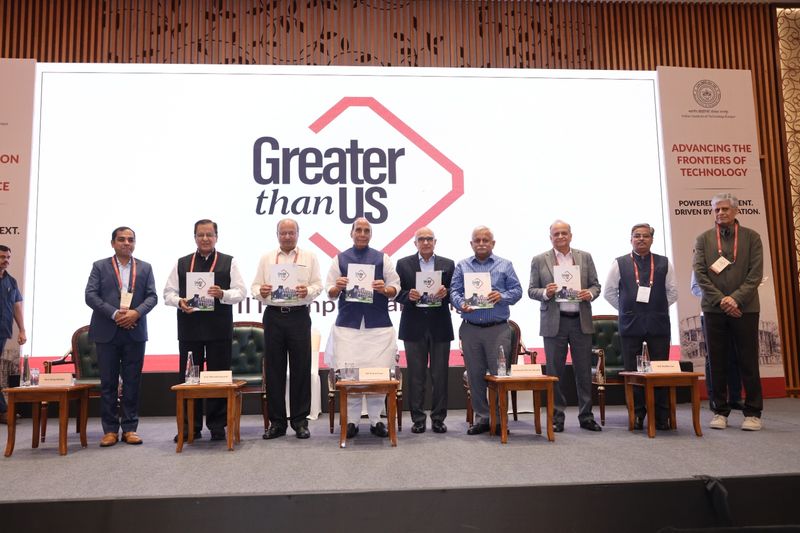
The Indian Institute of Technology (IIT) Kanpur on Wednesday launched ‘Greater Than Us’, a campaign to raise US$1 billion by March 2029, the largest fundraising campaign ever undertaken by an IIT.
Nearly half of the target, amounting to Rs 4,155 crore, has already been committed by alumni, donors, corporate partners and the government to help build an institution for the nation.
The campaign was launched by Defence Minister Rajnath Singh at Bharat Mandapam in New Delhi.
No IIT has previously attempted a fundraising campaign on this scale. The initiative brings together alumni, donors, industry and institutional partners to invest in foundational facilities and young Indians who will make discoveries, develop technologies and establish companies that a developed India will need.
At the launch, IIT Kanpur signed an MoU with its alumnus Rahul Gautam, who has committed Rs 180 crore to establish the Gautam School of Innovation & Entrepreneurship (G-SINE) at the institute’s Noida campus.
G-SINE will train a new generation of technology-driven founders and leaders for India’s high-growth sectors, including AI, cybersecurity, digital health, biotechnology, drones and advanced manufacturing. It will have its own full-time faculty and degree programmes and is scheduled to launch in July 2027 with a flagship MBA in Technology & Entrepreneurship.
Working alongside the proposed Deep Tech Hub at the Noida campus, G-SINE will give students access to advanced technology facilities to develop products from research. It will also draw on IIT Kanpur’s incubator, SIIC, which has incubated 571 startups.
Prof Manindra Agrawal, Director of IIT Kanpur, said: “What IIT Kanpur is setting out to build is greater than any one of us. It is an investment in the young Indians who will build this country’s future. Nearly half of this goal was committed before we announced it, and that tells us donors believe in where we are going. India cannot borrow the technologies that will define its future. We have to build them. The next deep-tech companies will start in a lab, not a garage, and G-SINE will train the founders who build them. This campaign is an invitation to every alumnus, partner and friend of IIT Kanpur to help write the Institute’s next chapter. Every commitment is tied to a defined purpose, whether a school, a facility, a chair or a programme.”
Launched by Defence Minister Rajnath Singh, the campaign is built on three pillars: Foundation, Talent and Frontier.
Foundation, with a target of Rs 5,000 crore, will develop the research and institutional infrastructure needed for IIT Kanpur’s next phase of growth. At its centre will be a Central Research Facility, which will give researchers shared access to high-end equipment, including a semiconductor and device processing centre with a clean room, as well as advanced spectroscopy and microscopy centres. A high-performance computing facility equipped with advanced GPUs will support research in AI and scientific simulation.
Talent, with a target of Rs 3,000 crore, will invest in exceptional students, researchers, innovators, entrepreneurs, faculty members and future leaders. It will fund scholarships and additional doctoral fellowships.
Frontier will support the development of a Quantum Technology Centre, planned as the first in the country to bring quantum hardware and software development together under one roof. It will also fund a Centre of Excellence for Semiconductor Packaging to support India’s push for chip assembly and testing plants; a medical devices prototyping and testing facility in a country that imports 80 per cent of its high-end medical devices; and a drug discovery programme focused on cancer, metabolic and neurodegenerative diseases.
