
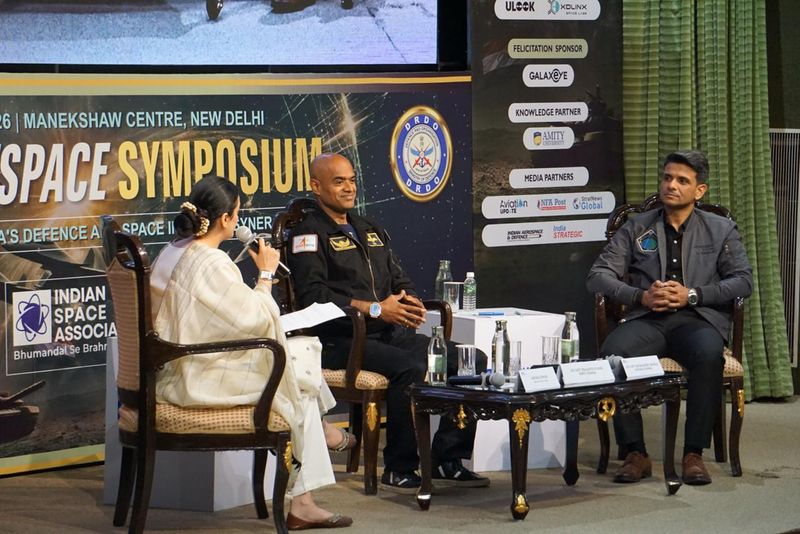
The Indian Defence Space Symposium (IDS) 2026, organised by the Indian Space Association (ISpA), concluded on Friday, with India’s astronauts underscoring the strategic significance of human spaceflight in shaping future capabilities.
India’s astronauts Group Captain Prashant B Nair and Group Captain Shubhanshu Shukla underscored the importance of innovation, collaboration and long-term vision at the symposium.
Shukla said “India stands at a point where expectations from our space programme are rising and we must evolve with that shift by investing in capability, innovation and collaboration.
If we align our resources and vision effectively, there is a real opportunity for India not just to participate, but to lead with unique, future-ready frameworks that others look to adopt.”
Highlighting the success of ISRO’s Chandrayaan and Mangalyaan missions, Shukla said that the world is looking up to India.
“The biggest visibility that we have got because of the missions that we have been able to do is how effective we were with the cost management. As we step into newer domains and more ambitious missions, I think it would need a lot more than what we have been doing. I would like to highlight is, there was also an element of surprise for the world. Anything that we were achieving, got highlighted, because people were really not expecting us to do a mission like Chandrayaan or Mangalyaan, reaching Mars in our maiden attempt or landing on the South Pole of the Moon. That surprise element is gone. People are expecting out of us now,” Shukla said.
Nair remarked that India’s journey into human spaceflight represents far more than a technological milestone, as it positions the country at the high table, where future rules of space will be shaped.
“As we move forward, civil-military fusion and indigenous capability will be critical not only for national security, but also for ensuring India plays a defining role for the global south in the evolving space ecosystem.”
“Once we go to space, we will be on the high table who makes the rules for outer space. When we go from the fighter cockpit to the space capsule cockpit, there is a bigger strategic role also on our shoulders because that involves diplomacy, it involves military strategy also and it involves more international relations because you know when you go to space we are interacting with all the other nations also,” Nair said.
