
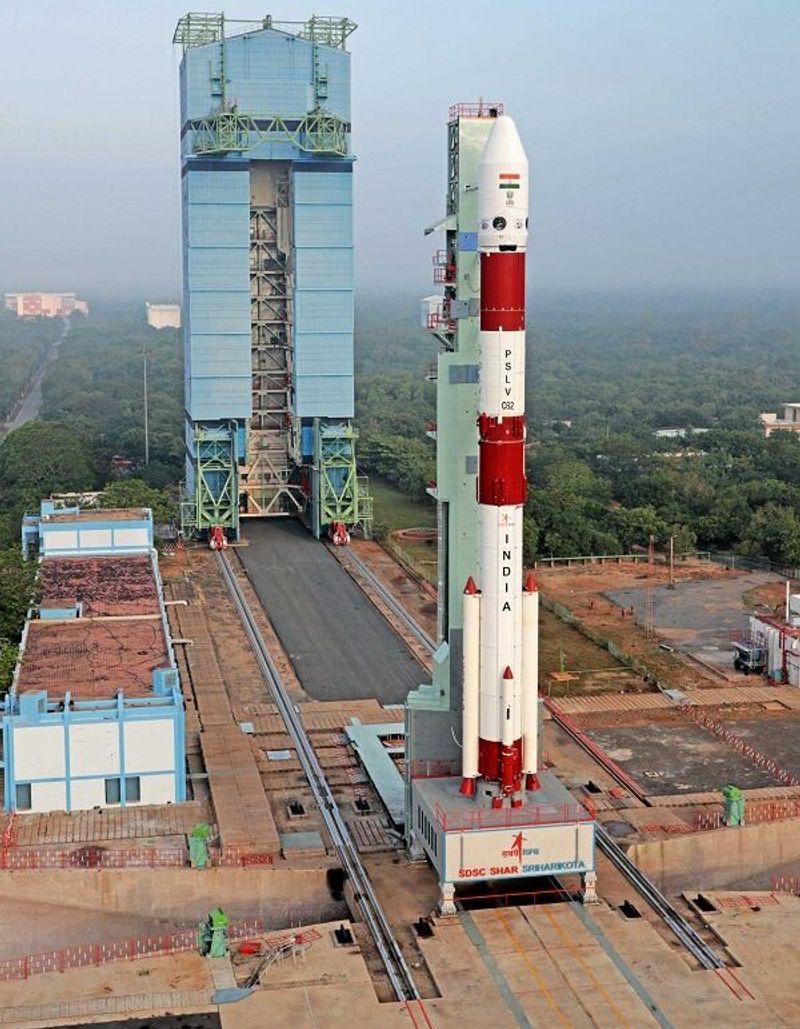
The Indian Space Research Organisation (ISRO) is set to begin this year’s space odyssey on January 12 with the launch of a military satellite, the EOS-N1 Anvesha, along with 15 other co-passengers from the Satish Dhawan Space Center in Sriharilota near Chennai.
The mission will be undertaken by the Polar Satellite Launch Vehicle (PSLV). Designated PSLV‑C62, it will be the rocket’s 64th flight and the ninth dedicated commercial mission undertaken by NewSpace India Limited (NSIL), the commercial arm of ISRO.
“The integration of the vehicle and satellites has been completed and pre-launch checks are in progress,” the space agency said on Thursday. Lift-off is scheduled for 10.17 am India time from the centre’s first launch pad. The PSLV-DL variant with two solid strap-on motors will be used.
The Military Satellite
The EOS-N1 is an advanced hyper-spectral imaging satellite developed by the Defence Research and Development Organisation (DRDO) for a “strategic user”. Unlike conventional imaging satellites, hyper-spectral satellites can see the earth in hundreds of wavelengths, enabling them to map and identify surface features and man-made objects with much greater precision.
This makes the EOS-N1 a high-value asset for national security with applications such as border surveillance and monitoring strategic regions. The satellite can also be used for civilian applications such as terrain analysis, urban mapping, mineral detection, environmental monitoring and disaster management.
The satellite will constantly scan the earth’s surface sending back images that can generate valuable intelligence. It will join India’s growing family of spy satellites that use radar and optical technology. India has an active programme to develop a fleet of military satellites for surveillance and communication.
The Mission Profile
The other co-passengers include eight projects by Indian firms, while the foreign clients include five technical, mapping and communication payloads from Brazil, an earth observation satellite built jointly by the UK and Thailand, a technology demonstration satellite from Nepal and a Kestrel Initial Technology Demonstrator (KID) from Spain and France. The KID, unlike the other payloads, is a prototype of a re-entry that would splash down in the South Pacific Ocean.
The total flight time for the mission after lift-off to the last payload separation is about 108 minutes, during which the maximum altitude that would be achieved is 511.262 km above the earth’s surface. The EOS-N1 would separate first from the rocket after 18 minutes when the space craft would be travelling at a velocity of 7608.7 meters per second or about 27,400 kmph. This would be followed by other payloads, with the KID Capsule separation being the last.
Other Indian Payloads
Among the notable Indian payloads on this mission are AyulSat from OrbitAid to demonstrate in-orbit fuelling. It is India’s maiden mission to validate technologies that could extend the operational life of satellites by enabling servicing and refuelling in space.
The MOI-1 from Dhruva Space and Takeme2Space that enables clients to run large AI models directly on the satellite, the LACHIT and Thybolt-3 from Dhruva Space and Don Bosco University for consellation development for multiple users are other important Indian payloads being put by the PSLV-C62 in space.
Standing 44.4m tall and weighing 260 tonnes, the PSLV is the workhorse for ISRO that has completed 63 flights, including notable missions like Chandrayaan-1, Mars Orbiter Mission, Aditya-L1 mission to the Sun and Astrosat Mission. In 2017, PSLV set a world record by launching 104 satellites in a single mission.
ISRO has at least seven satellite launches in its calendar for 2026. These include the G-1 and G-2 Uncrewed Orbital Test for the Gaganyaan human spaceflight programme, and other payloads strategic purposes, communications, earth observation and technology demonstrations. Some of these missions would be undertaken by the heavier Launch Vehicle Mark – 3.
