
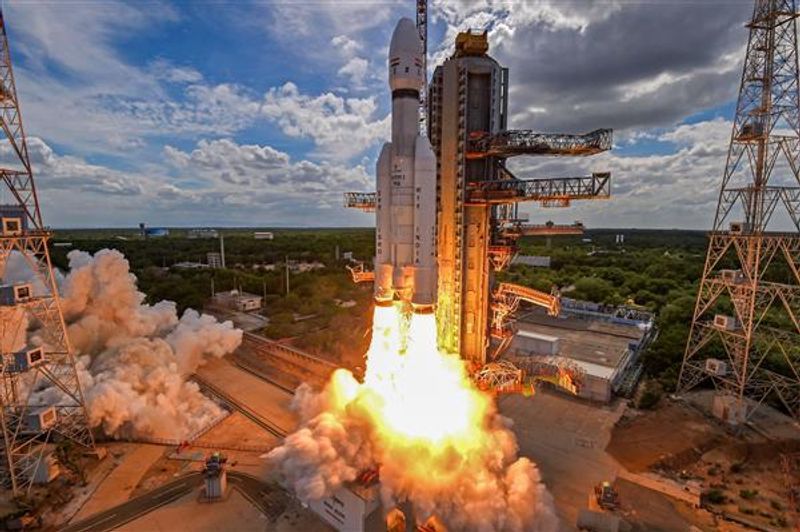
A new study by Indian scientists has given fresh insights into the complex physical and chemical characteristics of the lunar surface where India’s space mission, Chandrayaan-3 landed, enabling them to assess how soil and rocks at the site behave when exposed to extreme stress and heat.
During the final phase of the Chandrayaan-3 mission in 2023, the Vikram lander performed a successful ‘hop’ experiment, relocating itself to a secondary location through engine re-ignition. This manoeuvre provided a unique opportunity to study the lunar regolith, that is the moon’s dusty surface, and its response to plume–surface interactions.
The hop experiment was designed to validate the re-ignition capability of the lander propulsion system and to assess its ability to generate sufficient thrust for controlled lift-off, a critical requirement for future lunar ascent and sample-return architectures.
During this, the lander moved 50 cm under its own power and the on board Chandra Surface Thermophysical Experiment (ChaSTE) was redeployed and temperatures during the twilight transition were measured.
“This unique hop experiment provided new insights into the local-scale heterogeneities as well as thermo-physical and geotechnical environment in the vicinity of the landing site,” the researchers said in their study.
The engine firing resulted in the removal of the uppermost 3 cm of the regolith, exposing and slightly compacting the underlying material. In situ measurements and analysis revealed two distinct layers of soil and rock within the top 6.5 cm, with the upper layer characterised by a higher bulk thermal conductivity and the lower layer exhibiting a slightly lower thermal conductivity, the researchers said.
The study, undertaken by seven experts from ISRO’s Physical Research Laboratory and the Space Applications Centre, both at Ahmedabad, and Department of Engineering Physics, Andhra University, Visakhapatnam, has been published in the April issue of The Astrophysical Journal.
The study suggested that while the top layer loses heat rapidly to space after sunset, the lower layers exhibit more sluggish heat loss due to the low thermal inertia of the underlying regolith. “The unique conditions at the post-hop location, specifically the highly conductive top layer, produced unexpected diurnal thermal profiles. These findings underscore the presence of significant local heterogeneities in thermo-physical properties and their pronounced effect on lunar surface and subsurface temperatures,” it said.
Pointing out that understanding the moon and its near-surface environment is essential since it preserves the record of the early solar system evolution, the researchers said that at present, a comprehensive understanding of the complex thermal environment at high latitudes and polar regions remains lacking, particularly from in situ observations.
“These regions are of special interest, as they are considered favorable and potentially resource-rich environments for future human exploration and in situ resource utilisation,” they said.
