
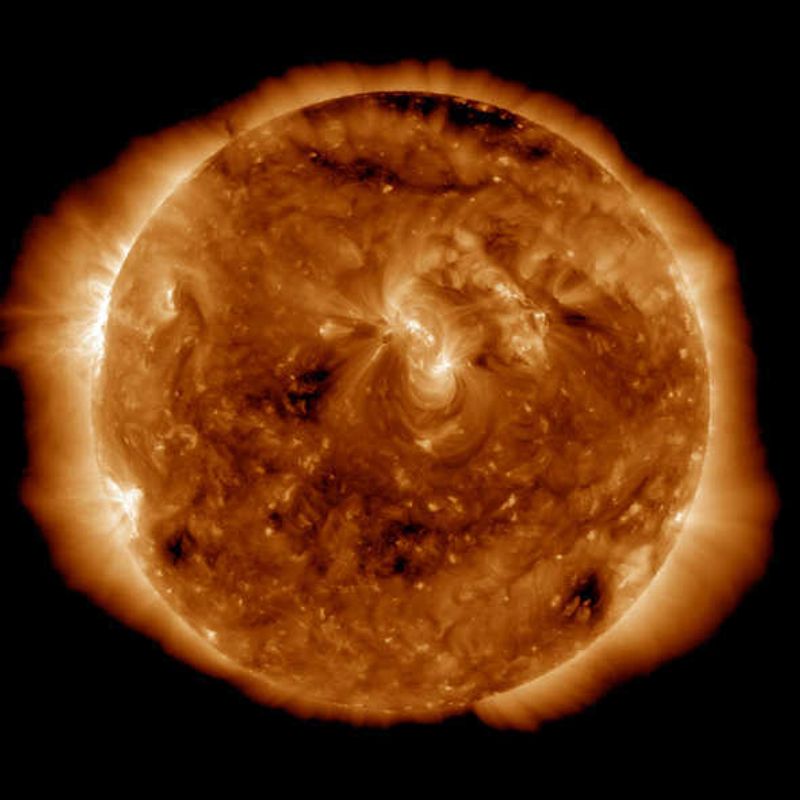
Researchers analysing solar coronal shocks triggered by solar flares have discovered the reason behind peculiar variations in the relative strengths of radio waves, called fundamental and harmonic emissions for different bursts.
The study improves scientists’ understanding of how solar shocks generate radio waves and how those waves travel through the corona and can help predict weather forecasting, according to information shared by the Ministry of Science and Technology on Friday.
Solar coronal shocks are large-scale plasma waves in the Sun’s atmosphere, driven by energetic solar flares or coronal mass ejections, which produce radio emissions of a particular kind, known as type-2 solar radio bursts. These bursts, also called slow-drifting bursts, generally travel at speeds of about 1,000 km per second and are detected in the radio waveband. Comparatively, coronal shocks can move at speeds up to 3,000 meters per second.
Type-2 solar bursts are identified based on characteristics such as drift rate, spectral index and various other plasma parameters and they slowly drift from high to low radio frequencies as the shock moves outward.
These usually appear in two parts—fundamental emission and harmonic emission. Theoretically, the fundamental is expected to be stronger than the harmonic, but observations show that in some cases the harmonic can be stronger than the fundamental. “The reason for such behaviour has not been thoroughly investigated earlier,” the researchers observed.
Studying the difference in strengths, a team of astronomers from the Indian Institute of Astrophysics (IIA) along with a scientist from Switzerland’s Istituto ricerche solari Aldo e Cele Daccò (IRSOL), analysed data from instruments located around the globe and traced the origin and characteristics of 58 type-2 solar radio bursts observed between June 13, 2010 and December 25, 2024, which provided new insights into the mystery.
Fourteen out of 19 bursts originating from heliographic or solar longitudes beyond 75 degrees exhibited a higher intensity, while 32 out of 39 bursts originating from longitudes below 75 degrees showed lower intensity, according to the study, published in Solar Physics, a peer-reviewed international journal.
“Our study finds that events originating from active regions located at solar longitudes greater than 75 degrees tend to show stronger harmonic emissions. In contrast, events originating closer to the solar disk centre exhibit stronger fundamental emissions,” K. Sasikumar Raja, the lead researcher explained in statement.
Such behaviour is attributed to the refractive effects in the solar corona, directivity and viewing angle of the solar radio emissions. Because of these effects, events at regions greater than 75 degrees cannot reach the Earth and thus appear either missing or weak. However, harmonics have broader cone angles and thus stronger emission can reach the Earth”, he added.
