
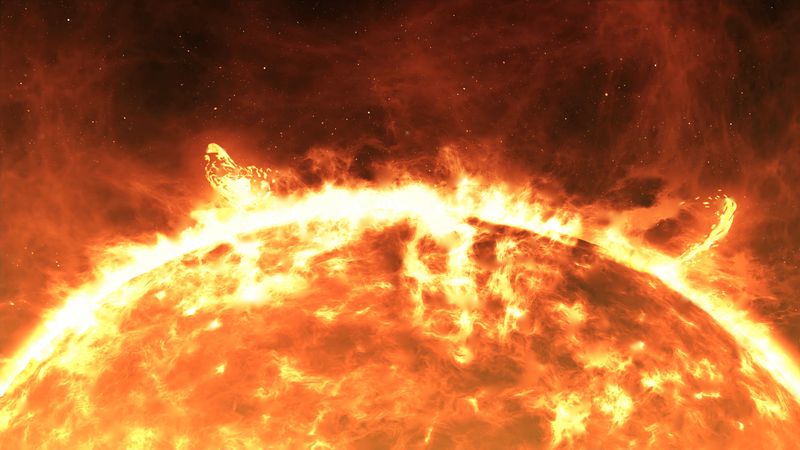
Indian astronomers have probed the mystery of why the poles of the Sun shine much brighter than the rest of the solar disk when mapped at specific microwave and radio frequencies, which could provide valuable insights into the magnetic field and temperature conditions in the Sun’s polar atmosphere.
The Sun’s polar regions play an important role in the evolution of its magnetic field and the generation of the solar wind, both of which affect the Earth. Besides being responsible for the occurrence of the northern lights and geomagnetic storms, these also impact satellite operations and radio communications.
However, despite decades of observations, the cause of microwave polar brightening, the enhanced radio emission seen near the Sun’s poles, has remained unclear, according to information shared by the Ministry of Science and Technology on October 12.
Earlier studies have linked microwave polar brightening to features such as polar coronal holes, polar faculae and magnetic fields. Coronal holes are dark regions where magnetic field lines are predominantly open, allowing the fast solar wind to escape. However, the contribution of each of these features and their role in the long-term behaviour of microwave polar brightening have not been fully understood.
Researchers from the Aryabhatta Research Institute of Observational Sciences, Nainital, Udaipur Solar Observatory, Mahatma Jyotiba Phule Rohilkhand University, Bareilly and the Indian Institutes of Technology at Delhi, Gandhinagar and Roorkee, carried out a comprehensive investigation of microwave polar brightening using nearly three decades of observations from the Nobeyama Radioheliograph (NoRH) — a dedicated radio device in Japan built to observe the entire surface of the Sun.
The radio data was combined with extreme-ultraviolet observations from NASA’s space-based Solar Dynamics Observatory and magnetic field measurements from the Wilcox Solar Observatory located in California to investigate the origin and long-term evolution of this phenomenon.
The studies revealed a clear north–south difference in the long-term evolution of microwave polar brightening and the area of polar coronal holes. To understand the role of coronal holes, the researchers compared microwave observations with the areas of polar coronal holes identified from extreme-ultraviolet (EUV) images.
The study found a strong relationship between microwave polar brightening and the size of polar coronal holes. An even stronger relationship was observed between microwave polar brightening and the strength of the Sun’s polar magnetic field.
These findings, published in The Astrophysical Journal, brought out by the American Astronomical Society, show that the long-term changes in microwave polar brightening are closely connected to the magnetic structure of the Sun’s polar atmosphere.
The researchers also examined individual microwave bright patches by comparing microwave observations with simultaneous extreme-ultraviolet images. They found that many of these bright regions coincide with small, bright features known as coronal bright points, which are formed by small-scale magnetic loops and are commonly found within polar coronal holes. In several cases, the bright regions were also linked to coronal jets, indicating continuous small-scale magnetic activity in the Sun’s polar atmosphere.
Stating that both large-scale and small-scale magnetic processes influence microwave polar brightening, the Ministry’s statement added that these findings provide strong observational evidence that microwave polar brightening is governed by the evolution of the Sun’s polar magnetic environment and highlight the importance of radio observations for understanding solar polar activity and the origin of the solar wind.
