
On a tennis court, a fraction of a second can change a point. But for Priyansh Agarwal, the bigger question was what happens after the shot: Can a player actually measure what went right or wrong?
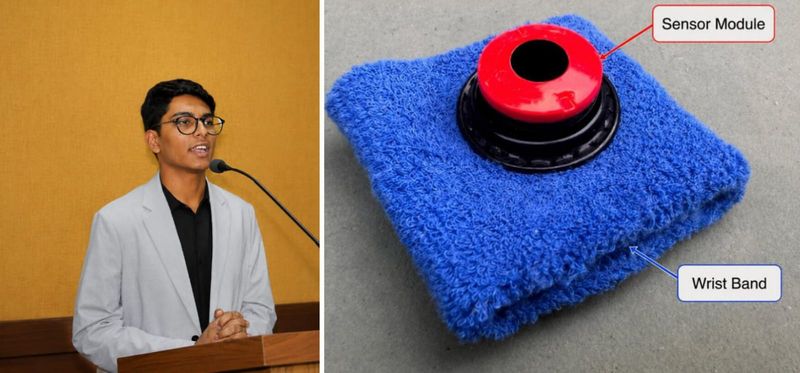
A national-level tennis player and Class 12 student at DPS Gurugram Sector 45, Agarwal turned that question into TennEdge, an AI-powered, motion-sensing technology designed to give players data-driven insights into their game.
“As a competitive tennis player, I constantly observed a major gap in the sport: getting objective, data-driven feedback is incredibly difficult for the vast majority of players. TennEdge started with a simple question: why shouldn’t all tennis players have access to the same kind of intelligence?” Agarwal told The Tribune.
From the court to the wrist
Inspired by sensor technology used in cricket, Agarwal began exploring how similar technology could be adapted for tennis.
TennEdge uses motion-sensing technology to capture and analyse a player’s movement, measuring parameters such as swing speed, shot accuracy, power and spin. The information is transmitted via Bluetooth to a companion application, turning aspects of a player’s performance into measurable data.
But getting the technology onto the court without disrupting the player proved to be a challenge.
“A tennis racket is extremely sensitive to weight and balance,” Agarwal said. Adding a sensor to the racket could alter its feel and performance. The solution was to integrate the sensor into a wristband that players already wear.
For Agarwal, the process of building TennEdge closely resembles the process of improving as an athlete.
“Tennis has taught me that performance is built through continuous iteration. You analyse what worked, identify what didn’t, make an adjustment and try again. I approach engineering in much the same way,” he added.
He developed the initial innovation independently, drawing on technical experience gained during his internship at StanceBeam.
The bigger idea: Teach students to build
TennEdge also pushed Agarwal towards another problem — the gap between learning technology in theory and actually building with it.
That led to Skill Bridge, an initiative aimed at giving students hands-on exposure to electronics, embedded systems and other industry-oriented technologies, while creating pathways towards employment.
“The biggest gap I see is between learning technology theoretically and actually building with it,” he said while talking to the correspondent.
Beyond elite athletes
Agarwal’s ambition for TennEdge is not limited to professional sport.
“Accessibility is one of the core motivations behind TennEdge. My vision is not to create a technology available only to elite athletes. I want young and amateur players to have access to meaningful performance data,” he said.
The immediate task is to take TennEdge from prototype to a robust, scalable product. Agarwal also hopes to expand Skill Bridge across the country and give thousands of students the kind of practical exposure that helped him develop his own innovation.
