
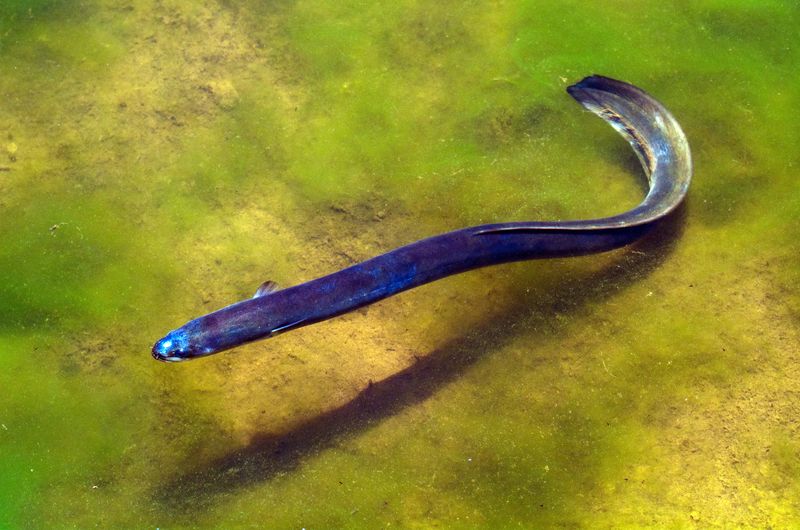
Researchers have discovered a new variety and species of underground earthworm eel living beneath the Indo-Gangetic Plain in Bihar.
The subterranean fish, a small, colourless creature named Gangaichthys indonepalicus, is the first to be recorded from the Gangetic Basin, an international team, including researchers from the Thackeray Wildlife Foundation in Mumbai, Zoological Survey of India in Gopalpur-on-Sea and Chinese Academy of Sciences, said.
Subterranean or underground fish are fresh and brackish water species adapted to life in caves, sinkholes and deep groundwater aquifers.
The scientific investigation began after a short video clip posted on TikTok in 2024 showed an unusual tiny fish emerging from a water borewell near the border between India and Nepal, the researchers said.
The unique morphology of the fish in the video, and the fact that there are no known stygobitic fish from the region, motivated us to track down the species to ascertain its identity, they said.
The word ‘stygobitic’ describes an aquatic creature exclusively adapted to living in subterranean environments, including caves and aquifers.
The team manually pumped thousands of litres of water from local handpumps to secure physical samples.
“Procuring samples of this unusual fish was challenging,” Akshay Khandekar, researcher at the Thackeray Wildlife Foundation and author of the study published in the journal ZooKeys, said.
“Identifying potential handpumps (borewells) and wells, and obtaining permission from their owners to extract water for the purpose of searching for the fish proved difficult. This became more intensive when we finally began manually pumping water,” Khandekar said.
The author said that the first specimen emerged after pumping about 2,000 litres of water, but sustained damage during the process and died immediately.
“The second and only intact specimen (later designated as the holotype of this species) was found from the same borewell after pumping an additional 500 litres of water,” Khandekar said.
The fish measures roughly four centimetres in length and features physical adaptations suited to life in total darkness, including reduced eyes covered by skin, an unpigmented translucent body, and an apparent absence of ribs.
Advanced micro-CT scanning and a genetic analysis confirmed that it represents a completely distinct genus within the earthworm eel family Chaudhuriidae, the researchers said.
“Gangaichthys means fish of the Ganga,” author Ishan Agarwal from the Thackeray Wildlife Foundation said.
“The Ganga or Ganges is one of the most important rivers in India, both as a source of fresh water, food and livelihood for millions of people; besides having an important role in the Hindu religion. This is the first stygobitic fish from the Indo-Gangetic plains and from the Gangetic basin,” Agarwal said.
The authors wrote, “Gangaichthys indonepalicus gen. et sp. nov., is described from the Indo-Gangetic Plain, Bihar, India. This is the first stygobitic chaudhuriid and first subterranean fish from the alluvial aquifers of the Gangetic Basin and Indo-Gangetic Plain, with all three specimens collected from borewells.”
