
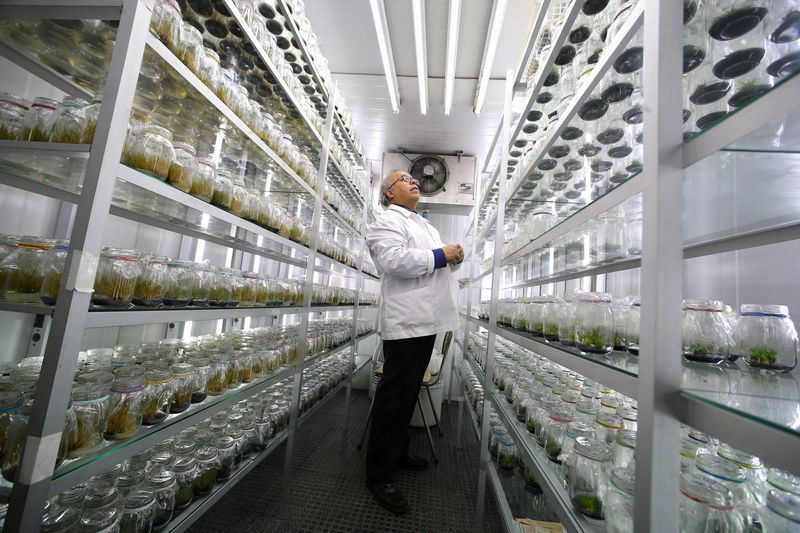
A team led by Chilean researchers has produced the most complete genetic map yet of one of only two flowering plants that grow naturally in Antarctica, potentially helping the development of crops resistant to extreme weather.
Colobanthus quitensis has long attracted scientific interest because it can survive the freezing temperatures, lack of water and high levels of ultraviolet radiation in Antarctica, one of the planet’s coldest and driest environments.
As record heat and extensive drought have increased the urgency of debate in many parts of the world over how to adapt agriculture, the scientists said they are now equipped to start assessing whether the plant’s traits could be transferred to agricultural crops through gene-editing techniques.
The study, published in Oxford University Press journal “Genome Biology and Evolution,” assembled all 40 chromosome-scale scaffolds that make up the plant’s genetic blueprint under a project known as Polarix.
“We were able to sequence and assemble the entire genome,” said Eduardo Castro, an associate researcher at Chile’s Cape Horn International Center and lead author of the study alongside Claudio Meneses of Chile’s Pontifical Catholic University.
“The idea is not to create transgenic plants. The idea is to edit the genome of a plant with nutritional value,” Castro said.
Identifying individual genes is easier once a genome has been mapped, but it can still take time. When that has been done, Castro said that scientists could need between five and 10 years to develop commercial applications.
A team in California supported the Chilean scientists, who said their work built on previous efforts by the Korea Polar Research Institute. That work produced only a partial version of the genome and was not published.
