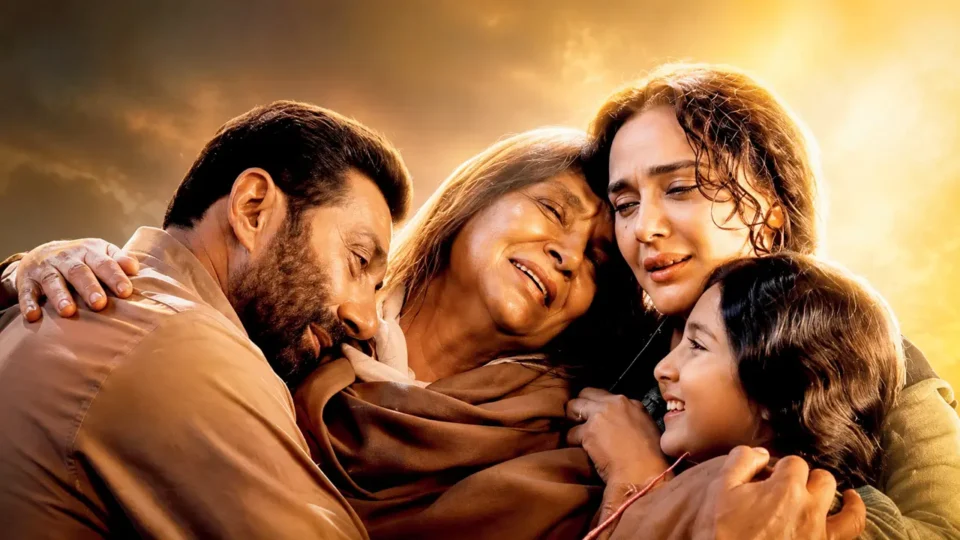
Film: Batwara 1947Director: Rajkumar SantoshiCast: Sunny Deol, Shabana Azmi, Preity Zinta, Karan Deol, Kanikka KapurRating: 2/5 stars
A series of ‘what ifs’ went through my mind, stepping out of Rajkumar Santoshi’s Batwara 1947.
What if this was a totally indie, art-house type film. Take Govind Nihalani’s gut-wrenching series, Tamas (1988), since this film’s dedicated to Nihalani (Santoshi’s mentor).
Or, Deepa Mehta’s Earth (1998) that starred Aamir Khan, who’s produced Batwara. Lemme not even bring up the GOAT, MS Sathyu’s Garm Hava (1974).
What if? Would I’ve felt differently about it? Maybe. The setting is Lahore, 1947. Barring the one family in it that’s moved from Meerut during Partition, the perspective is wholly local.
What if this was a Pakistani film, instead, with its own tone, and touch of atonement? Would I have been drawn to it furthermore? Perhaps.
Batwara is based on a popularly performed play, Jis Lahore Nai Vekhya, O Jamya E Nai, that I haven’t watched. The play (as the film, hence) is written by Asghar Wajahat.
So was Santoshi’s equally chatty, indoorsy yet fairly fine feature, Gandhi Godse (2023), indulging in counter-factual history that, strangely, equated in stature, an assassin, to the Mahatma.
This picture, similarly, you can tell, is far too faithful to the original play. Such that it doesn’t seem cinematic enough, for the longest passages.
And I don’t mean this for the lack of a ‘Sunny super-sound’ — just the fact of gasping for fresher air, along with its noble thoughts.
Consider the scene, where a shayar-type character (Ali Fazal, making a cameo) recounts to a bunch of blokes, the love of his life, from Lahore. The camera switches to a flashback for a romantic number that switches off, within a few seconds, almost mid-sentence.
Maybe music helps in such matters. We head over instead to the drudgery/dullness, within a home and neighbourhood, that appear so much like cookie-cutter sets for a period film.
At the core of Batwara, really, is a man’s love for another’s mother. Likewise, her love for another’s son. Their religions notwithstanding. You genuinely sense that loaded emotion for, max, 22 minutes in the movie.
I clocked it, between 12.02 and 12.24 pm, in a 10 am show! That’s when you experience the grand dame, habana Azmi, in her element; this film’s warmly glowing star.
Shabana plays a pious, old Hindu woman, somehow trapped in a haveli, that’s been assigned to a Muslim family, from across the border, as compensation, by the newly formed state.
Mirza, i.e. Sunny, is himself an unnecessary mohajir/migrant — thrown away into a distant land, dislodged from his own bearings and business, back where he comes from — having to start life anew.
He, along with his perennially pretty wife (Preity Zinta), li’l daughter, and a son (Karan Deol), who’s been an eye-witness to Partition’s extreme bloodshed, obviously see the original Hindu house-owner as, perhaps, a snake in their backyard.
Do you see the transition of Sunny’s character from someone grappling with his own trauma, to falling into the lap of a mother he never had? You hear it, yes. Do you feel it? Not really. And that’s possibly the unfortunate essence of this dry picture.
This protagonist is all alone, surrounded by his mohalla’s thugs and goons, led by a major rioter (Abhimanyu Singh), who discusses body-count from his blood-sport. This gangster obviously perceives Sunny’s character as the villain for protecting a lady from another faith.
Sunny takes him, and others, and pretty much the entire town, all by himself. The crowd parts, as if they know he’s the OG Sunny Paaji from Gadar, after all. People fly all over the place from his dhai kilo ka haath.
Which seems rather unrealistic as action for a movie that’s supposedly so realistic. At the same time, for the most part, Sunny appears far too subdued to be that Deol dude, in any case.
Either way, this confusion in the genre, perhaps, leaves both the movie star’s fans, and the genuine film buffs, somewhat unsatisfied. This is surprising, only because such a contradiction hardly ever held back the Sunny-Santoshi dramas (Ghayal, Ghatak, Damini) from their heydays.
Make no mistake, though. Batwara is also a really important film for what it’s attempting to say, even while being too literal. I don’t particularly have a problem with polemic, or a picture that’s preachy.
This one revisits Partition, without being revisionist. Yes, the tragic division of India, along religious lines, was a political move. But that land-grabbing took place, equally, on the streets. The opportunists inevitably took over.
And, maybe, this madness never ends. Neither does displacement. Look at the world around you. Or even Meerut in India, where Mirza’s family in this film comes from — it experienced the same kinda killings, even generations later. Those rioters were different from the set in Lahore. But they were still the same.
Santoshi-Wajahat strongly argue for religious coexistence, despite conditioning from faith, that teaches hate to fanatics alone. That all religions, chiefly Islam, in this case, expects mutual respect and empathy. And that politics mustn’t mix with religion, regardless.
This is a counterpoint in the heat of civil war over batwara, as it were. You gotta honour the intentions, sometimes. These are also those times. That’s quite separate from whether a film feels engaging enough, though.