
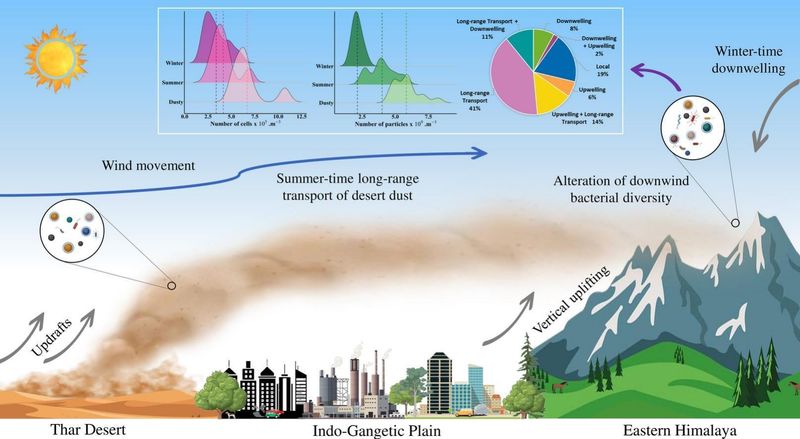
A new study has identified airborne pathogens carried along with elevated desert dust plumes from western India to the top of the Eastern Himalayas that are associated with respiratory and skin diseases. The research provides critical insights to strengthen national action plans for human health and development of health forecast systems.
The Himalayan hill-top atmosphere is widely considered beneficial for human health. Vulnerability in these regions has been found to be intensified by cold climatic conditions and hypoxia.
There is limited evidence connecting airborne microbial exposure to respiratory disease outcomes in high-altitude Himalayan populations, and the microbiological dimension of trans-boundary dust transport remains poorly understood, according to information shared by the Ministry of Science and Technology on Wednesday.
Over two years of continuous monitoring of dust storms rising from the arid regions of western India, researchers from Bose Institute and the Indian Institute of Tropical Meteorology found that powerful dust storms can travel hundreds of kilometers, crossing the densely populated and polluted Indo-Gangetic Plains before finally settling over the Himalayan hilltops. They carry airborne bacteria, including pathogens that can affect human health.
“About 80 percent of the total Himalayan bacterial population is due to long-range transport via horizontal and vertical movement of atmosphere, causing about 60 percent perturbation in Himalayan bacterial diversity,” the researchers said.
“Space-borne observations with three-days back-trajectories analysis reveal a thick dust layer between 2 and 3 km over the Eastern Himalayas coming from the Thar Desert,” the researchers added.
In addition to respiratory and skin diseases due to the transported pathogens, vertical uplift injects locally sourced pathogens into high-altitude atmosphere, where they mix with long-range travellers arriving from afar. Together, they reshape the bacterial community floating above the Himalayas, contributing to gastrointestinal infections also.
The results of this first of its kind study published in “Science of the Total Environment”, a peer reviewed international journal, quantitatively demonstrates the perturbation of atmospheric bacterial community over Himalayas due to horizontal long-range dust transport and vertical uplifting of foothill air pollution, which has direct implications on public health, according to the Ministry.
“The present results highlight the profound impact of atmospheric transport processes on regional bacterial diversity and public health in hill-top regions, highlighting Himalayan atmosphere as a dynamic and global conveyor of life, including pathogens across long distances,” the researchers said.
According to the study, airborne micro-organisms constitute a substantial fraction, up to 70 per cent, of atmospheric aerosols, exhibiting significant spatial and temporal variability. Despite the inhospitable nature of the atmosphere, characterised by low moisture, nutrient scarcity, intense solar radiation, and temperature fluctuations, many bacterial species persist in substantial numbers in air.
These micro-organisms primarily originate from natural sources like soil, vegetation and water bodies, playing critical roles in atmospheric processes and ecological equilibrium.
Airborne bacteria play a crucial role by engaging in chemical reactions and contributing to the production of cloud-condensation and ice-nucleating particles.
