
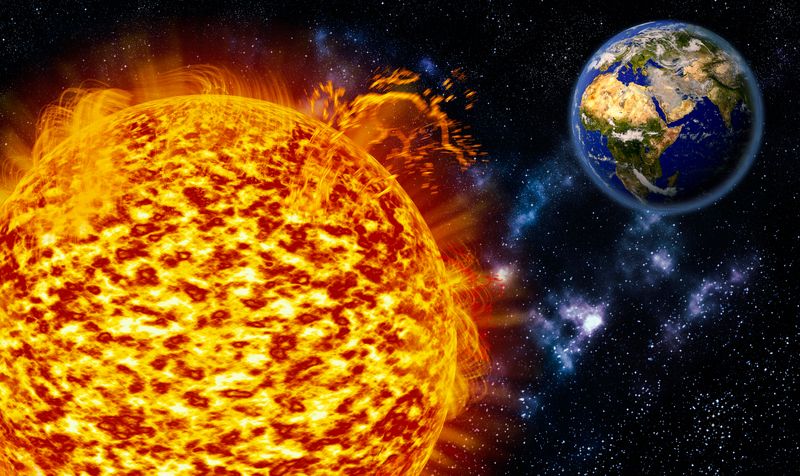
Astronomical data generated by the Indian Space Research Organisation’s (ISRO) Aditya-L1 solar mission has provided new insights into how a powerful solar storm impacts the Earth’s magnetic shield and poses hazards to satellites in orbit.
In a breakthrough study, scientists and research students from ISRO investigated a powerful solar storm that impacted the Earth during October 2024. The storm was caused by a massive eruption of solar plasma material from the Sun.
“The study revealed that the most severe effects occurred during the impact of the turbulent region of the solar storm, which was identified with the help of Aditya-L1 observations,” the space agency said on Saturday.
“This turbulent region strongly compressed Earth’s magnetic field, pushing it unusually close to the Earth and briefly exposing some satellites in geostationary orbit to harsh space conditions,” it added.
This phenomenon occurs only during severe space weather events. During the turbulent phase of the storm, currents in the auroral region (high latitudes) super intensified, potentially heating the Earth’s upper atmosphere and causing enhanced atmospheric escape, according to the study published in the current issue of Astrophysical Journal.
The finding of this study shows further importance of understanding of space weather phenomena and their real-time assessments to safeguard critical space assets.
Space weather refers to conditions in space caused by transient activity on the Sun, such as solar plasma eruptions, which can affect satellites, communication and navigation services, and power grid infrastructure on the Earth. During such strong space weather events, the Earth’s magnetic shield can be significantly disturbed.
The Earth’s magnetosphere acts as an invisible shield that protects the planet from harmful charged particles coming from the Sun. Aditya-L1 observed the structure of solar storm and helped in the assessments of its impact on the Earth’s environment along with data collected by other spacecraft around the Earth.
Launched in September, Aditya-L1 is India’s first space-based solar observatory, positioned between the Sun and the Earth— about 1.5 million km from the Earth—to study the Sun’s atmosphere and solar phenomena like flares and coronal mass ejections using seven on board instruments.
“This research provides crucial insights into the differential geo-effectiveness of interplanetary coronal mass ejections (ICMEs) structures, underscoring the critical need to accurately characterise sheath properties for improved space weather forecasting and mitigation,” the scientists said.
“Furthermore, this research holds significant importance for the study of the impact of ICME sheaths on various planetary systems around the Sun, as well as the interaction of stellar winds and CMEs with exoplanets,” they added.
