
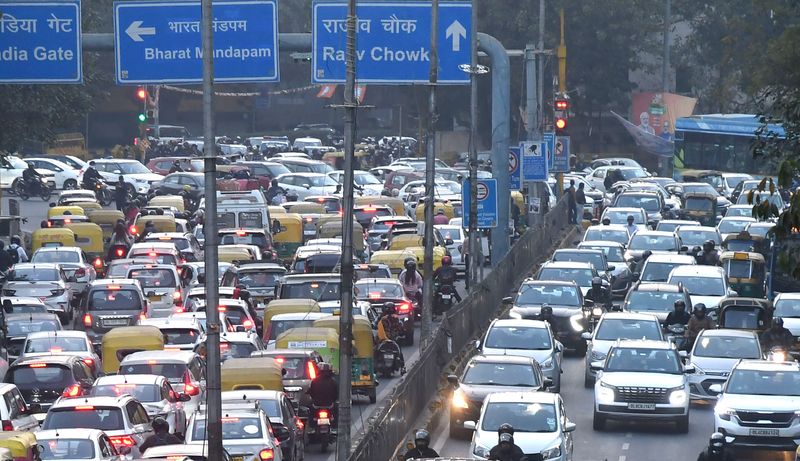
The impetus of development and poverty alleviation implies that environmental challenges are likely to worsen, unless immediate and sustained pollution mitigation can address the severe air quality problem in India, especially across the Indo-Gangetic Plains, a study by experts from India, Germany, and the US has cautioned.
Pointing out that Indian cities have recently emerged as some of the locations with the worst air pollution on Earth, the study reveals that the most urbanised districts also have the highest nitrogen dioxide (NO2) burden.
Districts at intermediate levels of urbanisation show both high levels of NO2 and the largest increases in NO2 pollution.
“Our analysis indicates that the Indo-Gangetic Plain (IGP) emerges as the region of particular concern in India from an air pollution perspective. This is particularly significant because the IGP houses two of the largest states in India by population, Uttar Pradesh and Bihar,” the researchers said.
The IGP is home to a dense concentration of coal-fired thermal power plants, industrial and mining activity containing over 90 percent of India’s iron ore and 84 percent of coal, transport and freight networks, intense agricultural activity, including the annual stubble burning resulting in haze, and household-level burning of biofuels for cooking, the study observed.
“The concern around the IGP identified by our analysis is consistent with both anthropogenic and meteorological factors. From the perspective of emissions, each and all of these sources of pollution should become the focus of mitigation efforts,” the researchers said.
The study, titled “Effects of urbanisation, scale, and geography on air pollution in India,” was undertaken by six experts from the Madras Complexity Collective, Chennai, Imperial College, London, German Aerospace Center, Wessling, Julius-Maximilians University, Germany, University of Chicago and Santa Fe Institute, both in the US. It was published by NPJ Clean Air, an international, peer-reviewed journal, on April 2.
Climatically, the IGP is flanked by the Himalayas to the north and the Deccan Plateau to the south, creating atmospheric conditions over the low-humidity plains that result in enhancing the atmospheric lifetime of NO2 from point sources such as power plants and industry, and its consequent dispersal over a broader area.
“These trends in NO2 pollution in the IGP are especially concerning since there will be significant intensification of economic activity in this region, given that the IGP remains one of the poorest regions in India — Uttar Pradesh and Bihar have the lowest per capita net domestic product among Indian states,” the researchers said.
Over the last decade, the government of India has intensified its focus on the economic and infrastructure development of this region, reflected in a 2:5X increase in the budget allocation to the north-eastern states in the decade 2014–15 to 2024–25. Thus, the economic growth of this region could meaningfully also increase its NO2 burden in the future, the study observed.
The two main challenges that lie ahead, the researchers said, are achieving systematic and steady improvements in the air quality of India’s largest and most polluted cities, and avoiding pollution increases in initially poorer, less urban but fast-developing regions of the country, especially in the IGP.
