
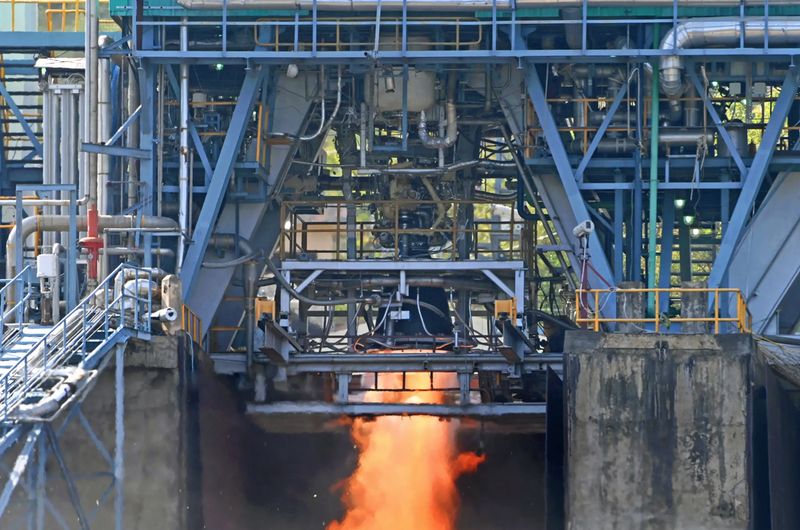
The Minister of State for Science and Technology, Dr Jitendra Singh, on Saturday congratulated the Indian Space Research Organisation (ISRO) for the successful sea-level hot test of the CE-20 Cryogenic Engine, which powers the upper stage of the Launch Vehicle Mark – 3 (LMV3), at enhanced thrust levels that enables higher payload carrying capability.
“The successful test featuring the nozzle protection system and multi-element igniter marks another important step in strengthening India’s advanced cryogenic propulsion capabilities and further enhancing the reliability of the LVM3 programme,” the minister said in a social media post on Saturday.
The latest test was carried out at 22-tonne thrust using nozzle protection system (NPS) and multi-element igniter at the ISRO Propulsion Complex, Mahendragiri on March 10. Earlier, such sea level tests were being carried out at 19 tonne thrust level, according to information shared by ISRO.
LVM3 is ISRO’s heaviest operational three-stage rocket, capable of launching over four tonnes to Geosynchronous Transfer Orbit (GTO) and eight tonnes to Low Earth Orbit. With nine launches so far, all of which have been successful, it has been used for missions like Chandrayaan-2 and Chandrayaan-3.
“In order to enhance the payload capability of the LVM3 vehicle, future missions of LVM3 are planned to be operated with an uprated C-32 stage with 22-tonne thrust for the CE-20 engine. In view of this, the flight acceptance test of the CE-20 engine also needs to be conducted at 22-tonne thrust level,” ISRO said.
“Therefore, the present test qualified the sea level testing of the engine with a test duration of 165 seconds at 22t thrust level using the NPS. The performance of the engine as well as the test facility was as expected during the entire test duration,” the space agency added.
Testing the CE-20 engine at sea-level poses considerable challenges primarily due to the high area ratio nozzle, which has an exit pressure of about 50 millibar. The main concern during testing at sea-level includes flow separation inside the nozzle, which leads to severe vibrations and thermal problems leading to possible mechanical damage of the nozzle.
The Cryogenic engine utilised for this test has undergone a record maximum number of 20 hot tests successfully. This has enabled the demonstration of several critical technologies using a single engine.
These include engine ignition using a multi-element igniter, ignition margin demonstration for the Gaganyaan over a wide range of propellant tank pressure and pre-ignition chamber pressure, engine qualification for the Gaganyaan at 20-tonne thrust level, demonstration and qualification of 22-tonne thrust level operation.
Boot-strap mode starting of CE-20 engine without start-up system for enabling restart in flight, indigenous turbo-pumps bearings qualification, indigenous sensor qualification and nozzle protection system qualification for high area ratio nozzle hot test at sea level are other key technologies that have been validated.
