
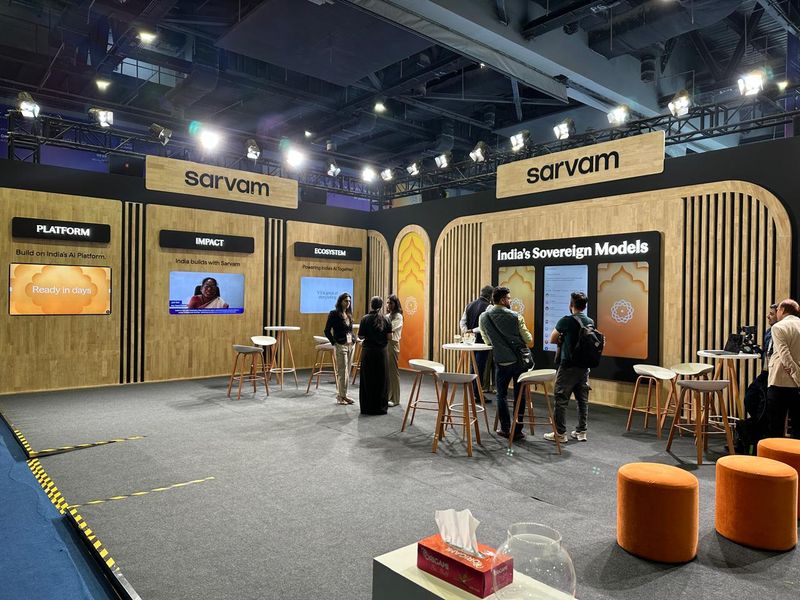
India’s artificial intelligence (AI) journey has taken a significant step forward with Sarvam AI unveiling two new home-grown large language models (LLMs) at the India AI Summit. The 30-billion-parameter and 105-billion-parameter models are designed to power everything from real-time conversations to complex reasoning tasks. For a country aiming to build a sovereign AI ecosystem, the development is both strategic and practical.
What are large language models?
In simple terms, large language models are AI systems trained on massive amounts of text data so they can understand, generate and respond to human language. They power chatbots, virtual assistants, translation tools, coding helpers and more.
The “parameters” mentioned, 30 billion and 105 billion, refer to the number of internal connections the model uses to learn patterns. Generally, more parameters mean more capability, but also more computing cost and complexity.
Sovereign AI push
Sarvam AI was selected under the Centre’s IndiaAI Mission in April 2025 to help build the country’s first sovereign LLM. A sovereign model means AI that is developed, trained and deployed within the country, aligned to Indian languages, culture, governance needs and data security priorities.
This reduces dependence on foreign AI systems and ensures that sensitive data remains within national boundaries.
30B model: real-time conversations
The 30-billion-parameter model is designed as a production-ready conversational engine. It is pre-trained on 16 trillion tokens (words and text units) and supports a 32,000-token context window, allowing it to handle long conversations and detailed queries.
What makes this model efficient is its mixture-of-experts (MoE) architecture. Instead of activating all 30 billion parameters for every response, it activates only about 1 billion at a time. This reduces computing cost and speeds up responses.
According to Sarvam co-founder Pratyush Kumar, while larger models are more capable, they are also harder to train and deploy.
Where will you see its benefits?
Customer care chatbots in banking, telecom and e-commerce
Government service portals answering public queries
Healthcare helplines guiding patients
Education platforms offering tutoring support
Local language assistants for rural users
The model supports Indian languages, which is critical in a diverse country where English is not the primary language for most citizens. It also performs competitively against global models of similar size on benchmarks such as HumanEval, MMLU and coding tests — indicating strong technical capability.
105B model: For complex reasoning
Sarvam’s second model, the 105-billion-parameter LLM, is aimed at advanced reasoning tasks. It activates around 9 billion parameters when generating responses. It also supports a much larger 1,28,000-token context window, enabling it to process very long documents. This model is built for maths problem solving, coding and software development, bug detection, research analysis.
Real-world impact
The advanced reasoning ability opens doors across sectors:
Software and startups: Developers can generate code, debug errors and accelerate product building.
Legal access: AI can simplify legal research, draft documents and explain laws in regional languages.
Education: Step-by-step help in maths, science and coding.
Governance: Policy analysis and document review can become faster and more data-driven.
At the launch, Sarvam AI co-founder Pratyush Kumar said these models were on a par with most other open and closed frontier models of its class, and designed to do complex reasoning tasks very well. The 105-billion-parameter model could meet most benchmarks, and was also cheaper than Google’s Gemini Flash and yet outperformed its many benchmarks, he claimed.
