
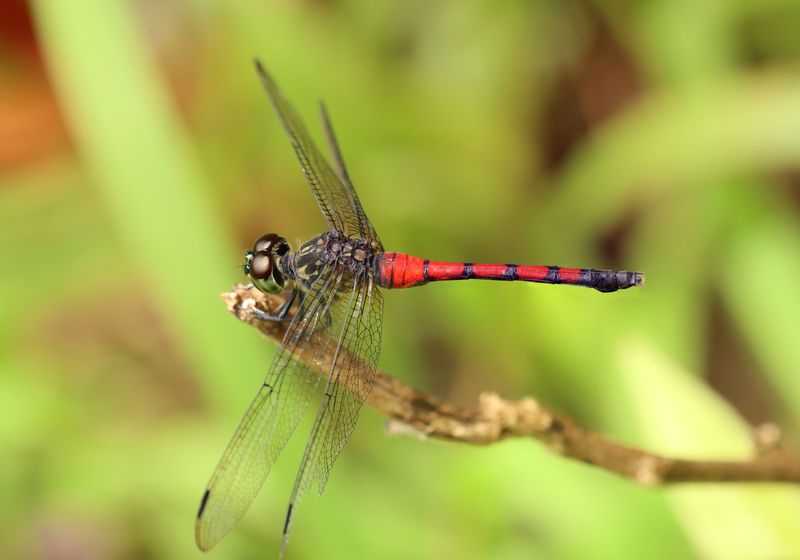
Researchers have identified a new dragonfly species, Lyriothemis keralensis, found in the low-lying coastal plains of Kerala. Commonly known as the Slender Bombardier, the insect was formally identified after more than a decade of investigation, researchers said on Sunday.
After extensive research, it was finally distinguished from its close relative, Lyriothemis acigastra, which is found in Northeast India.
The breakthrough, led by a collaborative team including Dr Dattaprasad Sawant, Dr A Vivek Chandran, Renjith Jacob Mathews, and Dr Krushnamegh Kunte, was recently published in the International Journal of Odonatology.
First sighted in 2013 in the Varappetty region of Kothamangalam, scientists initially believed the dragonfly was part of the Lyriothemis acigastra or Little Bloodtail odonate family, widely found in northeastern India.
However, recent specialised studies revealed that Lyriothemis keralensis has unique physical and behavioural characteristics that qualify it as a distinct species of odonate.
The research paper published in the International Journal of Odonatology explains that, apart from Little Bloodtail, Lyriothemis keralensis has a slim abdomen and a unique tail and genital structure.
Males are characterised by a deep blood-red abdomen with black markings, while females, slightly broader, display yellow and black colouration.
Measuring approximately three centimetres in length, Lyriothemis keralensis was confirmed through the study of century-old museum specimens.
The species is unique in its habitat preference, thriving in irrigation landscapes such as pineapple and rubber plantations rather than in protected forest sanctuaries.
It is commonly found in shaded vegetated canals and seasonal pools within these agricultural areas.
Vivek Chandran, one of the researchers, emphasised the need for a shift in conservation perspective, as this species is only sighted in human-dominated irrigation areas.
“It is crucial that our actions for the preservation of biodiversity do not focus solely on forests. Odonates, in particular, occupy a wide variety of habitats, and the existence of this species reminds us of the urgent need to preserve biodiversity within human habitats and private farmlands as well,” Dr Vivek said.
As a seasonal resident, Lyriothemis keralensis emerges during the monsoon and retreats as the rains fade, he added.
Because its survival depends heavily on specific microhabitats located outside traditional national parks, researchers highlighted that its future rests on human effort and the preservation of local ecosystems within agricultural lands.
